

Website Design and SEO: Why They Should Be Planned Together
Can a website underperform when design and SEO are handled separately? Yes-but when they are planned as one system, the website has a much better chance of standing out.

Can a website underperform when design and SEO are handled separately? Yes-but when they are planned as one system, the website has a much better chance of standing out.
A Good Website Needs Both Visual Appeal and Search Visibility
A visually impressive website can still struggle to attract visitors, even when its keywords have been carefully selected. In many cases, the problem is that the design and SEO were not planned together.
One team may approve the site structure and visual design before the SEO specialist becomes involved. In another scenario, search-optimized content is completed without a user-friendly interface, a clear message, or an obvious next step. That is when the revisions begin: new sections, reorganized navigation, rewritten headings, and links inserted after the fact.
The key principle behind modern website structure is that website design and SEO are not two services that should be connected at the end of a project. They are two sides of the same system. One helps people find and understand the website; the other helps turn visitors into customers as efficiently as possible. When they are planned together, there are fewer compromises, the user journey is clearer, and the website gains a practical foundation for long-term growth.

What Goes Wrong When Web Design and SEO Are Handled Separately?
The problem usually does not begin with a poorly written meta description. It starts much earlier. For example, every service may be placed on a single page even though customers use entirely different search queries to find them. Or an approved template may provide space for three icons and two short paragraphs but leave no room to explain the process, present supporting evidence, or answer frequently asked questions.
An attractive website does not automatically satisfy search intent. Likewise, keywords cannot rescue confusing navigation or a mobile interface where visitors cannot find the next step. When content, design, and development move in different directions, all three will eventually require revisions.
In practice, this can mean creating new URLs, restructuring the sitemap, adding missing headings, inserting internal links, and measuring conversions again. Meanwhile, the designer, SEO specialist, and developer are making decisions about the same issues-but at different times and with different information.
The purpose of integrated website design and SEO services is to prevent these problems by making critical decisions while they are still easy to change. We plan first, then design and develop. The website is therefore not an SEO plan wrapped in a finished design. It is the result of coordinated business, content, design, and development decisions.
Start With the Structure: Keyword Research, Sitemap, and Wireframe
Before discussing colors, fonts, or animations, three basic questions need clear answers:
- What does the business offer?
- What are its customers searching for?
- What action should visitors take on the website?
These answers form the website’s actual framework. Keyword research helps determine which topics need dedicated service pages, which should become local landing pages, and which are better suited to articles or case studies. If two searches reflect different questions and different decision-making situations, answering both on the same page may not be effective.
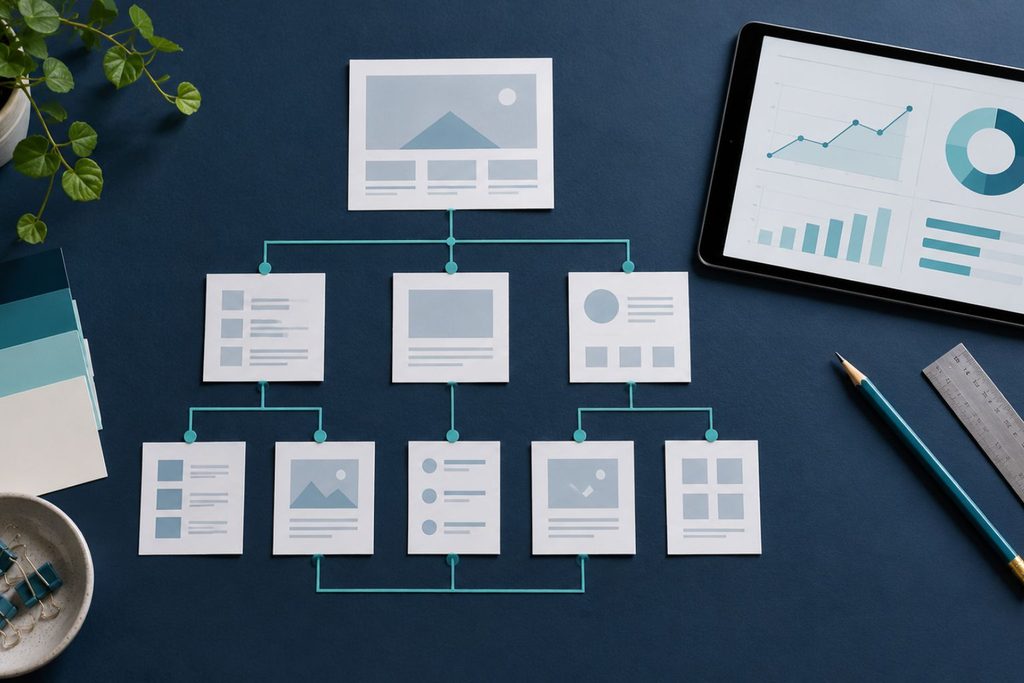
The next step is the sitemap. A sitemap is not an administrative formality; it is a route map. It shows how service pages, local pages, insight articles, and case studies connect. This forms the basis of the information architecture: the system that helps both visitors and search engines understand the purpose of each page.
Before visual design begins, the wireframe defines the order of the content, the heading structure, the placement of supporting evidence, the calls to action, and the main page sections. Changes are still quick and relatively inexpensive at this stage. Once the visual design has been approved, they become more difficult.
In HelloProVision’s Web Design & Development process, research directly informs the sitemap and wireframe. SEO & Local Search also serves as one of the starting points for the website structure.
Our process in brief: business goals and search intent → sitemap → wireframe and content hierarchy → design → development and technical SEO → internal linking → measurement and optimization.
Design for People While Keeping the Website Clear to Search Engines
Good design should look polished, but its most important function is to help visitors understand the offer faster. Visual hierarchy shows them the primary message, where to find supporting evidence, and what to do next. Clear headings, a logical content sequence, and consistent navigation reduce the amount of time visitors spend trying to understand the page.
The same structure also gives search engines useful context. This does not mean an attractive layout automatically earns higher rankings. Design is not a search-ranking shortcut. It matters because it affects the readability of the content, the relationship between page sections, and whether important pages and links are accessible.
This is where the web design SEO services approach becomes practical. If a service requires a detailed explanation, the interface must provide enough room for it. If visitors need a quick answer, the main point should not be hidden behind five animations. The purpose of the visual design is not to compete with the message but to make it easier to see and understand.
This becomes even more important on mobile devices. A responsive layout is not a compressed copy of the desktop website. It must preserve the essential content, clear headings, usable navigation, and easily accessible calls to action. In simple terms, a strong mobile experience means less searching, faster understanding, and easier decision-making.
Technical SEO Should Be Part of Development, Not a Later Fix
Technical SEO requirements must be included in the development specification before implementation begins. These requirements include crawlable navigation, indexable content, a logical heading structure, responsive layouts, and consistent handling of title tags and meta description fields. Requirements omitted from the specification usually have to be added later through bug reports and corrective development work.
Performance also requires specific technical standards. Oversized images, autoplaying videos, unused JavaScript, and third-party scripts can increase loading times and negatively affect Core Web Vitals. Image sizes, fonts, animations, and third-party tools should therefore be reviewed throughout development.
During a redesign or migration, every old URL must be mapped to its destination URL, along with any required 301 redirect. New URLs must be checked for canonical tags, indexability, XML sitemap inclusion, robots.txt rules, status codes, and internal links.
Technical SEO is part of the website development specification. Analytics and conversion-tracking events must also be defined in advance. Launch QA should not be considered complete until tracking for forms, clicks, phone calls, and other conversions has been tested.
Internal Linking Gives Visitors a Clear Route Through the Website
Internal links function like road signs: they work when they show visitors the right next step at the right time. A service page may lead to a relevant case study, an insight article may link to a related service, and a city page may direct users to the solution the company provides in that area.
The goal is not to maximize the number of links. A page does not become more useful simply because every other sentence is clickable. Internal linking works when each link genuinely supports navigation and its anchor text tells readers what they will find on the destination page.
Link placement should therefore be defined during the wireframing stage. This prevents service, city, insight, and case study pages from becoming isolated pieces of content and allows them to support one another. A natural link to Web Design in Fort Myers within a relevant local example is more useful than repeating Fort Myers, Cape Coral, and Naples at the end of every section. A good link moves the visitor forward. A bad one simply hangs there without a clear purpose.
The Website’s Actual Performance Becomes Clear After Launch
Launching the website is not the end of the work. It is the first time we can observe real visitors making real decisions. Search Console can show which searches trigger the website’s pages, which results receive clicks, and where organic visibility changes. The GA4 landing page report can reveal where sessions begin, how users engage with the website, and whether the events that matter to the business actually occur.
This is why rankings should not be the only metric. A page may attract traffic while generating no CTA clicks or form submissions. In that case, the problem may not be the keyword. It may be the message, the supporting evidence, or the next step.
Measurement and conversion tracking show whether search visibility leads to meaningful business activity. Landing-page performance, CTA usage, inquiries, and the content that supports purchasing decisions should be evaluated together. Measurement provides the evidence needed to decide what should be improved next.
When Should One Team Handle Both the Website and SEO?
An integrated approach is especially useful for a new website, redesign, or migration because the structure, content, design, development, and often the URL system are changing at the same time. When one decision affects five others, it should not be made through five separate conversations.
A coordinated team may also be necessary when new services or local markets require changes to the site hierarchy, reliable conversion tracking is missing, or responsibilities are getting lost between multiple vendors.
This does not mean every project requires a full team. In some cases, targeted technical improvements, a new landing page, or a content update may be enough. Whether someone searches for a website design SEO company or a website design and SEO company, team size matters less than the quality of the collaboration.
The same applies to website design and SEO packages. The name of the package proves nothing by itself. The process is what matters: do the research, sitemap, wireframe, design, development, and measurement all support the same business objective?
Strong results do not require a shared invoice. They require coordinated planning and decisions made at the right stage.